 IRA rules and regulations for precious metals
What Is IRA Eligible Gold?
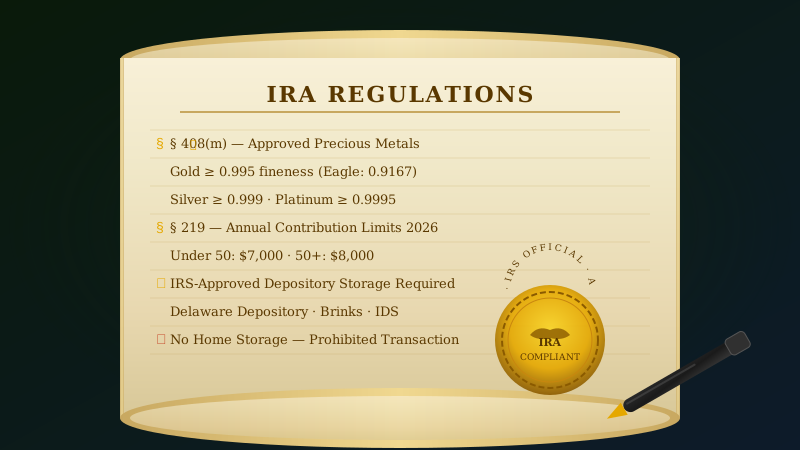
IRA-eligible gold is physical bullion satisfying three IRS criteria under IRC §408(m)(3): (1) minimum 0.9950 fineness, (2) production by an IRS-recognized mint or accredited refiner, and (3) storage in an approved third-party depository — not at home. These rules, established by the Taxpayer Relief Act of 1997, disqualify collectibles, rare coins, jewelry, and any gold stored outside an IRS-approved facility.
A self-directed IRA (SDIRA) — not a standard brokerage IRA — is the required account vehicle, as it allows alternative assets including physical bullion. When you purchase IRA-eligible gold, you acquire bullion whose gold content, fineness hallmark, and exact weight specifications are confirmed by an assay certificate from the refiner. The custodian holds legal title; you retain beneficial ownership and direct the investment decisions. Consult IRS Publication 590-A and 26 U.S.C. §408(m) for the authoritative statutory language.
IRS Purity Standards: The 0.995 Rule and Metal-by-Metal Thresholds
The IRS sets minimum fineness at 0.9950 for gold, 0.9990 for silver, and 0.9995 for both platinum and palladium — with one statutory exception for the American Gold Eagle, which qualifies at 91.67% purity (22 karat) under IRC §408(m)(3)(A).
IRA-qualifying gold bars achieve 0.9950 minimum fineness — with premium bullion-grade products reaching .9999 fine (24 karat) — carry hallmarks from LBMA-approved refiners like PAMP Suisse or Valcambi, and include an assay card and serial number confirming exact troy ounce weight and purity. Bars, rounds, and coins must also be produced by a refiner or assayer accredited by at least one of: NYMEX, COMEX, NYSE/Liffe, LME, LBMA, LPPM, TOCOM, or certified to ISO 9000 standards, or manufactured by a national government mint. A bar listed on the LBMA Good Delivery List automatically satisfies accreditation requirements and is considered COMEX-deliverable. (Source: IRS Pub. 590-A; Taxpayer Relief Act of 1997; LBMA Good Delivery Rules 2023)
Unmarked bars — those without purity hallmarks or recognized refiner certification — fall into the IRC §408(m)(1) collectibles category and legally cannot reside in a self-directed IRA, triggering a deemed distribution equal to the purchase price, subject to income tax and potential penalties.

IRA-Approved Gold Coins: 2026 Complete List
The following gold coins meet the IRS 0.9950 fineness threshold (or qualify by legislative carve-out) and are produced by recognized government mints. Each is accepted by major SDIRA custodians. IRS-approved bullion coins must be in brilliant uncirculated condition; proof coins must include original mint packaging and a certificate of authenticity.
IRA-Approved Gold Bars: Approved Refiners & Specifications
The following coins and bars currently satisfy IRS eligibility requirements for precious metals IRAs as of 2026.
IRA-Approved Gold Bullion Coins (Detail)
- American Gold Eagle (1 oz, 1/2 oz, 1/4 oz, 1/10 oz) — 22k (91.67% pure); qualifies by explicit IRC §408(m)(3)(A) carve-out
- American Gold Buffalo (1 oz, 24k / 0.9999 fine) — U.S. Mint proof and uncirculated versions
- Canadian Gold Maple Leaf (1 oz, 1/2 oz, 1/4 oz, 1/10 oz; 24k / 0.9999 fine) — Royal Canadian Mint, LBMA-approved
- Austrian Gold Philharmonic (1 oz, 24k / 0.9999 fine) — Austrian Mint, LBMA-approved
- Australian Gold Kangaroo/Nugget (1 oz, 1/2 oz, 1/4 oz, 1/10 oz; 24k / 0.9999 fine) — Perth Mint, LBMA-approved
- British Gold Britannia (1 oz, 24k / 0.9999 fine) — Royal Mint, eligible since 2013 redesign
IRA-Eligible Gold Bars
Gold bars offer lower spot price premiums (1–3% vs. 3–8% for coins) and greater cost efficiency for allocations above $50,000. IRA-eligible gold bars achieve 0.9950 minimum fineness, carry hallmarks from LBMA-approved refiners, and include a serial number and assay card confirming exact troy ounce weight and purity. Bars produced by PAMP Suisse, Valcambi, Heraeus, Johnson Matthey, and the Royal Canadian Mint are accepted by all major SDIRA custodians — verify your specific custodian’s approved-refiner list before placing an order, as acceptance of Credit Suisse bars and Perth Mint Certificate Program products varies by custodian.
The Collectibles Rule: What Gold Is Prohibited
The IRC §408(m)(1) collectibles prohibition bans rare coins, numismatic pieces, and bullion from unaccredited sources — regardless of gold content. Specifically prohibited are: South African Krugerrand (no legislative carve-out despite 91.67% gold content), Austrian Corona, British Sovereign, pre-1933 rare coins, coins graded by PCGS or NGC, and any commemorative issues.
Proof coins may qualify only if they are produced by a government mint in brilliant uncirculated condition, carry original mint packaging, and include a certificate of authenticity. Confirm with your custodian that the specific proof edition is accepted before placing an order, as proof eligibility can differ across custodians.
Prohibited collectibles — Krugerrands, British Sovereigns, Austrian Coronas, and graded numismatic coins — trigger a deemed distribution under IRC §4975 the moment an IRA acquires them, with the full purchase price added to ordinary income and subject to a 10% early withdrawal penalty if under age 59½. This prohibited transaction rule was affirmed in McNulty v. Commissioner, 157 T.C. No. 10 (2021). Home storage gold IRA schemes — often marketed as a "checkbook IRA" — fall under the same prohibited transaction rules and have been consistently disallowed by the IRS and Tax Court.
How Physical Gold Is Stored in an IRA: Approved Depositories
IRA-eligible gold resides exclusively at IRS-approved depositories such as Delaware Depository (Wilmington, DE) or Brink’s Global Services (multiple U.S. locations) — home storage, even in a personal safe, constitutes a prohibited transaction under IRC §4975. A self-directed IRA (SDIRA) holds physical gold through a three-party structure: you (the account owner), a qualified IRS-approved custodian, and an approved depository — you never take personal possession.
IRA-eligible gold assigns legal title to the custodian while preserving your beneficial ownership and investment-direction rights. Other IRS-approved facilities include International Depository Services (IDS) and CNT Depository. All carry Lloyd’s of London insurance coverage and undergo independent third-party audits. Segregated storage vaults your specific coins and bars under your name (higher cost, maximum traceability); commingled storage pools metals by type with ownership tracked by weight (lower cost, less individual traceability).
Home storage gold IRA schemes — marketed as a "checkbook IRA" loophole — violate IRS rules and have been consistently struck down in Tax Court rulings. Storing IRA gold at home constitutes a taxable distribution under IRC §4975, triggering income tax plus a 10% early withdrawal penalty if under age 59½.

Why Investors Add Gold to a Retirement Portfolio
Gold has maintained purchasing power across inflationary cycles: during the 1970s stagflation period, gold prices rose from ~$35/oz to $850/oz. In 2022, when U.S. CPI hit 9.1%, gold held within 5% of its 2020 peak while the S&P 500 declined 19.4%. A portfolio with 5–15% gold allocation has historically reduced maximum drawdown by 8–12 percentage points in equity bear markets (source: World Gold Council, 2023 Portfolio Analysis Report).
Gold’s correlation with the S&P 500 averaged just 0.05 over the past 20 years, making it one of the most effective non-correlated diversifiers for retirement portfolios. Unlike stocks and bonds, physical gold carries no counterparty risk — it cannot default, be diluted, or go bankrupt.
Tax Advantages: Traditional vs. Roth Gold IRA
A Traditional Gold IRA grows tax-deferred — contributions may be deductible, and taxes are paid on withdrawal as ordinary income. Required minimum distributions (RMDs) begin at age 73 under SECURE Act 2.0. With physical gold, RMDs can be taken as in-kind distributions (gold shipped to you) or liquidated for cash within the IRA.
A Roth Gold IRA uses after-tax contributions, and qualified withdrawals — including all gold appreciation — are completely tax-free. Roth IRAs have no RMDs during the owner’s lifetime, making them ideal for investors who want to pass gold holdings to beneficiaries without forced liquidation. Choosing between Traditional and Roth depends on your current marginal tax rate vs. expected retirement tax rate.
Contribution Limits, Rollovers, and Transfers (2026)
In 2026, the IRS contribution limit is $7,000/year ($8,000 if age 50+). Rollovers from a 401(k), 403(b), TSP, or existing IRA carry no dollar cap and are tax-free when executed as a direct trustee-to-trustee transfer. A direct rollover moves funds between custodians without you ever touching the money — eliminating the risk of the 60-day rollover window and mandatory 20% withholding on indirect rollovers.
The 60-day rollover rule allows one indirect rollover per 12-month period across all your IRAs (per IRS Rev. Rul. 2014-15). Missing the 60-day deadline converts the distribution into a taxable event: the full amount is added to ordinary income for the year, and investors under age 59½ owe an additional 10% early-withdrawal penalty on the gross distribution. A direct trustee-to-trustee transfer eliminates both the 20% mandatory withholding and the 60-day clock risk entirely — making it the overwhelmingly preferred method for gold IRA funding.
Opening a Precious Metals IRA Step by Step
- Choose the right custodian: Select an experienced custodian specializing in precious metals IRA administration
- Select an IRS approved depository: Your physical gold must be stored in an approved facility with robust insurance
- Fund your account: Use contributions within IRS limits, or transfer/rollover from existing accounts
- Choose your eligible gold: Decide on products that meet IRS purity standards
- Execute the purchase: Instruct your custodian to purchase from approved dealers
- Maintain compliance: Keep records of transactions and review custodial statements
- Review your strategy: Periodically evaluate allocation and whether to include other precious metals
Gold IRA Fees: Setup, Annual, Storage & Hidden Costs
Gold IRA investors typically pay $50–$150 setup, $75–$300 annual custodian, and $100–$300 annual storage fees — totaling $225–$750/year before transaction costs. Some companies also charge wire transfer fees ($25–$50 per transaction) and account termination fees ($50–$150).
Beyond custodian fees, investors pay a spot price premium when purchasing gold — the amount above live spot price charged by the dealer. Coins typically carry a 3–8% spot price premium; bars carry 1–3%. The bid/ask spread (difference between dealer buy price and sell price) is an additional hidden cost: dealers typically buy back coins at spot −2% to −5% and bars at spot −1% to −3%, meaning total round-trip transaction costs can reach 6–13% on coins. A non-bank trustee (specialty SDIRA custodian) may charge a separate transaction fee of $40–$100 per purchase plus a wire transfer fee of $25–$50 per disbursement. Storage billing varies by depository: the Delaware Depository charges a flat annual rate based on account value tiers, while Brink’s Global Services may charge per-ounce. Always request a complete written custodian fee schedule — including setup, annual, storage, wire transfer, and liquidation fees — before opening an account.
Segregated vs. Allocated vs. Commingled Storage
Segregated storage keeps your specific bars and coins individually vaulted under your name — you receive the exact same serial-numbered items upon distribution. Allocated storage holds your metals in a pooled vault with your ownership recorded by weight and type, but you may not receive the identical bars you deposited. Commingled storage pools metals across multiple clients with no individual tracking — the lowest-cost option but with the least traceability. Most financial advisors recommend segregated or allocated storage for gold IRAs.
Coins vs. Bars: Which Is Better for Your IRA?
Coins offer greater liquidity and easier RMD in-kind distributions — fractional gold coins (1/10 oz, 1/4 oz, 1/2 oz American Gold Eagles) allow you to distribute small denominations without liquidating a full troy ounce. Coins carry higher spot price premiums (typically 3–8% for Eagles and Maples) and a liquidity premium that reflects their divisibility and collector demand, but they generally have tighter bid/ask spreads on resale compared to bars. Most major gold IRA companies offer a buyback program for coins, providing a guaranteed exit price.
Bars offer lower premiums over spot price (typically 1–3%) and are more cost-efficient for large allocations above $50,000. However, bars are less divisible for partial distributions and may take longer to liquidate via a custodian buyback program. Most advisors recommend a blended approach: fractional coins for RMD management and liquidity, LBMA Good Delivery bars for cost efficiency on the core allocation.
IRS-Approved Depositories and Security
All physical gold held in a retirement account must be stored in an IRS-approved depository under the control of your qualified custodian. The two most widely used depositories are the Delaware Depository (Wilmington, DE) and Brink’s Global Services (multiple U.S. locations). Both carry Lloyd’s of London insurance coverage and undergo independent third-party audits.
Metals ship directly from the authorized dealer to the depository via insured armored transport — you never handle or receive the gold. Quarterly statements from your custodian confirm exact holdings by weight, type, and serial number (for segregated accounts). Storing IRA gold at home, in a personal safe, or in a bank safe-deposit box violates IRS rules and constitutes a taxable distribution.
Rollovers and Transfers: Direct vs. 60-Day
A direct trustee-to-trustee transfer is the safest method: your existing custodian wires or ACH-transfers funds directly to your new gold IRA custodian. No withholding, no time limits, and unlimited transfers per year. This method works for Traditional IRA, Roth IRA, 401(k), 403(b), 457(b), and TSP accounts.
An indirect (60-day) rollover sends a check payable to you. Your employer plan withholds 20% for taxes, and you must redeposit 100% of the original amount within 60 calendar days — including replacing the 20% from your own funds — or the shortfall becomes taxable income plus a 10% penalty if under 59½. The IRS allows only one indirect rollover per 12-month period across all your IRAs (per Rev. Rul. 2014-15). At distribution, Traditional Gold IRA holders may elect an in-kind distribution process — receiving physical troy ounces of bullion rather than cash — which avoids a forced liquidation but triggers ordinary income tax on the fair market value of the distributed gold.
Risks and Considerations: What Is the Downside of a Gold IRA?
Gold IRAs carry five primary downsides investors must evaluate before committing retirement funds:
- Higher fees: Annual fees of $200–$500 (setup $50–$300, custodian $80–$300, storage $100–$300) erode returns — especially on smaller accounts below $25,000. By contrast, a GLD ETF charges just 0.40% annually with no setup or storage fee.
- No dividend or interest income: Physical gold generates zero yield. Total return depends entirely on price appreciation, meaning a flat gold market produces a negative real return after fees.
- Illiquidity vs. ETFs: Liquidating physical gold through an SDIRA custodian takes 3–5 business days. A GLD share trades in milliseconds with bid/ask spreads under 0.1%, versus 3–8% bid/ask spreads on gold bars and 5–10% on coins when reselling.
- Wide bid/ask spreads: The numismatic premium and liquidity premium on physical coins creates an immediate mark-to-market loss at purchase. A 1 oz American Gold Eagle bought at spot + 5% requires a 5.3% gold price increase just to break even after the dealer's buyback bid.
- Gold price volatility: Despite its inflation-hedge reputation, gold has experienced 30–40% drawdowns — notably from $1,900/oz in 2011 to $1,050/oz in 2015 — and delivered negative real returns over certain 10-year periods.
Most financial planners recommend limiting gold to 5–15% of total retirement portfolio value to capture diversification benefits while controlling concentration risk and fee drag.
Gold IRA vs. Physical Gold at Home: Which Is Better?
A Gold IRA and personally-owned physical gold (home storage or bank safe-deposit box) serve fundamentally different purposes:
A Gold IRA defers or eliminates taxes on appreciation — a significant advantage over 10–20 year horizons — but adds $200–$500/yr in fees. Personally-owned bullion offers instant liquidity and no custodian dependency, but gains are taxed at the collectibles rate (up to 28%) rather than the 0%/15%/20% long-term capital gains rate that applies to stocks and bonds.
Can I Hold Gold in a Fidelity, Vanguard, or Schwab IRA?
No. Fidelity, Vanguard, Charles Schwab, and TD Ameritrade IRAs do not custody physical gold bullion. These standard brokerage IRAs restrict holdings to publicly traded securities: stocks, bonds, mutual funds, and ETFs. An investor wanting IRS-approved physical gold exposure through a brokerage IRA is limited to gold ETFs like GLD, IAU, or GLDM — which track gold prices but do not convey ownership of physical metal.
To hold actual gold bars or coins in a retirement account, investors must open a self-directed IRA (SDIRA) with a specialty custodian such as Equity Trust Company, STRATA Trust Company, Kingdom Trust, or GoldStar Trust. The SDIRA custodian then purchases IRA-eligible bullion from an authorized dealer and arranges direct shipment to an IRS-approved depository — the account holder never takes possession.
What If You Invested $10,000 in Gold 20 Years Ago?
In April 2006, gold traded at approximately $600 per troy ounce. A $10,000 investment would have purchased roughly 16.67 troy ounces of .9999 fine bullion-grade gold. By April 2026, with gold at approximately $2,300 per troy ounce, those same 16.67 troy ounces would be worth approximately $38,340 — a total return of 283% and a compound annual growth rate (CAGR) of approximately 7.0%.
For context over the same period:
- S&P 500 (with dividends reinvested): ~10.3% CAGR
- U.S. 10-year Treasury bonds: ~3.8% CAGR
- Gold (no dividends): ~7.0% CAGR
- U.S. CPI inflation: ~2.6% CAGR
Gold outperformed bonds and inflation but trailed equities over this 20-year period. However, a 10% gold allocation to an S&P 500 portfolio would have reduced maximum drawdown during the 2008–2009 financial crisis by approximately 8–10 percentage points (source: World Gold Council, Portfolio Analysis Report 2023). Note: these figures are historical and do not predict future performance. Spot price premiums, bid/ask spreads, and custodian fees reduce net IRA returns versus raw price appreciation.
Bar Weights, Specifications, and Purity
For IRA eligible bars, check exact weight specifications such as 1 oz, 10 oz, or 1 kilo, and confirm that each bar is stamped with weight, fineness (0.995 or better), and a recognized hallmark. Serial numbers and certificates may be required by your depository and custodian. For gold bullion coins, verify the gold content and weight from approved government mints.
How to Evaluate Gold IRA Companies and Custodians
When choosing among gold IRA companies, evaluate experience with self directed IRAs, clarity of fees, selection of approved precious metals, dealer relationships, and quality of depository partners. Read agreements carefully so you know how custodians charge for transactions, shipping, insurance, and account administration. Good service should include education on IRS requirements and transparent timelines from order to storage.
Strategic Allocation: How Much Gold Should You Hold?
There is no single rule for all investors. Some retirement strategies allocate 5% to 10% of a portfolio to physical gold to enhance diversification, while others may allocate more if they have specific concerns about inflation or currency. Your allocation should fit your risk tolerance, time horizon, and income needs. A self directed IRA offers the flexibility to hold gold alongside other assets. Regularly review your allocation to ensure your retirement portfolio remains aligned with your goals.
Liquidity and Distributions
When it is time to take distributions, you may instruct your custodian to sell metals for cash within the IRA or take in-kind distributions, in which case gold is shipped to you and taxed accordingly. Required minimum distributions apply to traditional IRAs beginning at the applicable age. Consider keeping some cash or liquid assets in your self directed IRA to handle fees and distributions efficiently.
Comparing Gold to Other Assets
Including gold in a retirement account provides an alternative to mutual funds, stocks, and bonds. While equities may offer growth and income potential, they can be sensitive to market cycles. Gold behaves differently and can help offset volatility. Combining physical gold with traditional assets can strengthen diversification. No approach eliminates risk, and diversification does not guarantee profits or prevent losses.
Practical Tips Before You Buy
- Verify eligibility: Confirm that the gold products you plan to buy are truly IRA eligible and meet IRS purity standards
- Mind the paperwork: Ensure your custodian and depository coordinate shipping, receipt, and storage promptly
- Budget for fees: Understand custodial fees, storage fees, and transaction costs
- Know your minimums: Ask about minimum investment requirements before you purchase
- Plan your exit: Consider future liquidity and potential need for RMDs when choosing between bars and coins
Realistic Expectations About Returns
Gold can appreciate significantly over long horizons, but it can also experience periods of stagnation. Because physical gold does not generate income, total return depends on price movement. Your time horizon, risk tolerance, and reasons for holding gold should guide expectations. Many investors use gold as a stabilizer within a diversified retirement portfolio rather than as a sole growth engine.